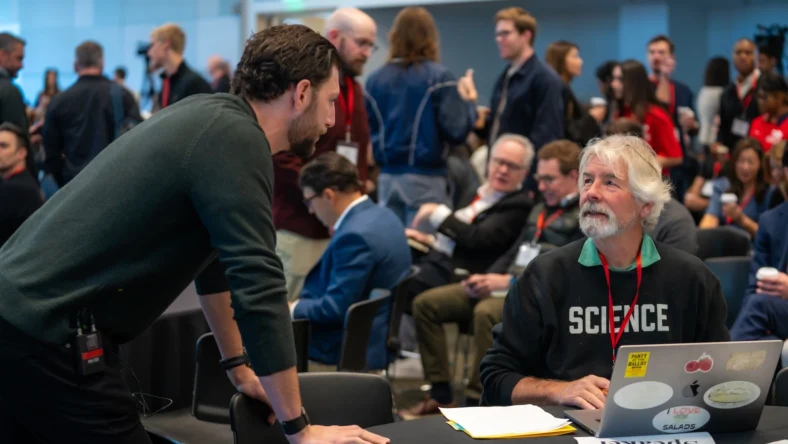
From GLP-1 adherence challenges to the clinical future of wearables, Stanford’s sold-out event mapped the science, business models and behavior change required to move preventive health beyond its early-adopter phase and into mass adoption
The first Stanford University Consumer Health Conference brought together founders, clinicians, operators and investors shaping what has become a sprawling wellness economy. More than a showcase for new products or fast-growing categories, the sold-out event focused on a more fundamental question: if consumer health is advancing so quickly, why are public health outcomes still lagging?
That question shaped the day from the outset. In his opening remarks, organizer Zach Teiger acknowledged the gap between the category’s momentum and its broader reach.
“We have this consumer health and well-being movement that’s growing, that’s attracting capital, that’s attracting awareness,” Teiger said. “And yet we still have a mental health crisis. We still have an obesity epidemic. We still have a healthcare system under strain.”
“As it stands today, the consumer health and well-being movement has not influenced population health outcomes,” he added. We have not moved the needle on the most important aspects of Americans’ health and well-being; not yet.”
From there, the conference moved into a series of conversations that reflected just how much the consumer health landscape has changed.
Wearables, once defined largely by fitness tracking, are increasingly being discussed as part of a broader health infrastructure. Metabolic platforms are moving beyond static nutrition plans toward more dynamic, personalized care. Investors who once dismissed consumer health as too soft or too narrow are now treating it as a serious and scalable market.
The “Quantified Self” panel captured that evolution clearly. Alex Vannoni of Whoop described how the company has expanded beyond its original niche in performance and athletics.
“We started as sort of a wearable for elite athletes and performers, and very quickly and the pandemic was a big catalyst for this,” he said. “We’ve become much more of a health companion and and healthcare company.”
Ricky Bloomfield, the chief medical officer at Oura, framed a similar shift through a clinical lens as the smart ring maker aims to position wearable data as more than a set of wellness metrics.
Bloomfield pointed to the company’s pandemic-era research as an example of how consumer devices began moving closer to medical relevance.
“We found that we could detect COVID 2.75 days earlier than someone could with a COVID test,” he said.
Even so, the broader point was not simply that consumer devices can detect more. It was that their long-term value depends on what users do with that information.
“How do we help change behavior in positive ways?” Bloomfield said. “I’ve certainly found that my behavior has changed just just using a device like this.”
That same distinction between information and action carried into the “Metabolic Health in Everyday Life” panel, where Stanford nutrition scientist Christopher Gardner joined Michael Snyder and Noom CEO Geoff Cook for a discussion that was as much about adherence as it was about technology.
Gardner pushed back on the idea that better frameworks alone solve metabolic disease.
“The biggest study I ever ran was a weight loss study with 600 adults for a year,” he said, using that experience to underscore how often outcomes are shaped less by the diet itself than by the realities of how people live.
Cook described a market that is becoming increasingly interconnected, with wearables, diagnostics and clinical care functioning less as separate verticals and more as parts of the same system. He also emphasized the practical difficulty of delivering personalization at scale.
“A coach is never going to fully understand every meal you’ve eaten, all of your blood work … all of your care decisions,” he said.
The conversation then moved into GLP-1s, one of the day’s most consequential topics.
Rather than treating the drugs as a simple breakthrough, panelists discussed them as a powerful but incomplete tool. Cook described the pattern that many care platforms are now seeing:
“A lot of people come in on a GLP-1 or have previously been on a GLP-1, they stopped, they experienced probably weight regain, they came back,” he said.
He also pointed to retention as one of the central challenges: “11 out of 12 people will be off the GLP1 after 36 months.”
The larger takeaway was that these therapies may open the door to change, but they do not replace the need for sustained behavioral support. That brought the panel back to a broader structural issue that surfaced repeatedly throughout the day: prevention remains difficult to scale when the system is still built to reimburse treatment more readily than proactive care.
Snyder captured that plainly. “Nobody pays to keep you healthy,” he said.
Later in the day, the investor panel offered a different perspective on the sector’s maturation.
Julie Yu of Andreessen Horowitz captured how dramatically sentiment has shifted in only a few years. “A few years ago, it was like a death sentence to call yourself a consumer health company to VCs,” she said.
That shift reflected the fact that the category is beginning to produce businesses with more durable models, clearer consumer demand and stronger operating discipline than it once did.
By the close of the conference, the prevailing message was not that consumer health has solved anything, but that it has entered a more serious phase.
“As it stands today, we’re serving the people in this room,” Teiger concluded, alluding to the high socioeconomic status of the event’s attendees. “And there’s nothing wrong with that. We’re the early adopters. We’re already motivated. We’re usually generally healthy. We’re informed and we have the disposable income to do something about our health. But the people that are getting left behind are the average American who is time-poor.”