
New data from move-to-earn app WeWard shows 63% of Americans walk fewer than 7,000 steps a day, with gaps across age, income levels and gender
When it comes to walking, Americans need to step it up, according to a new report from move-to-earn step tracking app WeWard.
Analyzing data between January and December 2025, from roughly 15 million users worldwide, including over three million Americans, WeWard found that the U.S. ranked second to last in daily average steps in comparison to other Organisation for Economic Co-operation and Development (OECD) countries, ahead of only Canada.
Nearly two-thirds (63%) of Americans walk less than 7,000 steps a day, the report found, with women and young adults falling the furthest behind within the U.S. WeWard focused on 7,00 specifically, as researchers have observed clinically meaningful improvements in health outcomes when people hit that target.
Among those countries, Spain claimed the No. 1 spot, with an average daily step count of almost 9,000.
Breaking down the U.S. stats further, there are some serious demographic and geographic discrepancies correlated with higher and lower step counts.
State-by-State Variations
Of all 50 states, New York was the only one to average over 7,000 steps, with 42% of New Yorkers hitting the benchmark on average.
The higher average income in New York was also found to be correlated with more steps, joining states like Massachusetts, Washington and California to combine relatively strong walking activity with higher average wages. Lower-income states such as Mississippi, Alabama and West Virginia saw lower step counts.
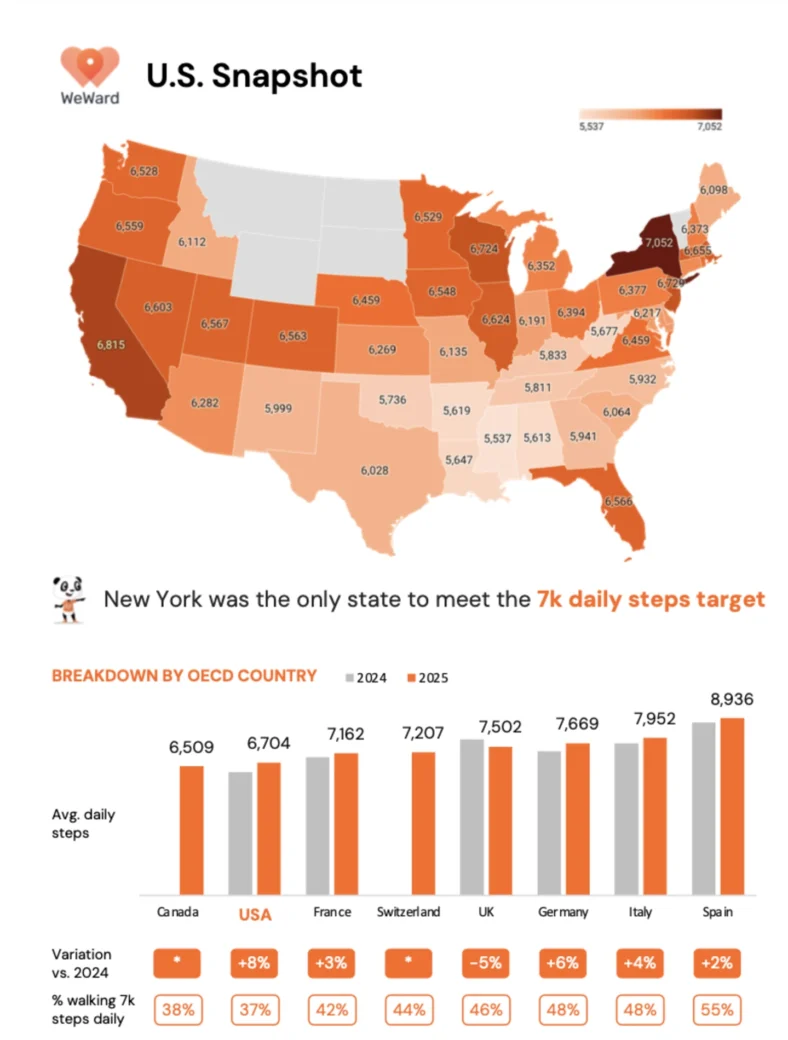
The report also revealed that states with higher average daily step counts also had populations that seem to live longer, with Hawaii, Massachusetts, New Jersey and Minnesota all having relatively high walking levels (over 6,000) and the highest life expectancies.
It seems like walking more may not just help Americans live longer, but also improve that quality of life as well.
States like Utah, Colorado, New Jersey and Massachusetts with higher average daily step counts generally reported lower diabetes and obesity prevalence, potentially demonstrating the association between broader lifestyle habits and metabolic health.
More Screen Time, Less Walking
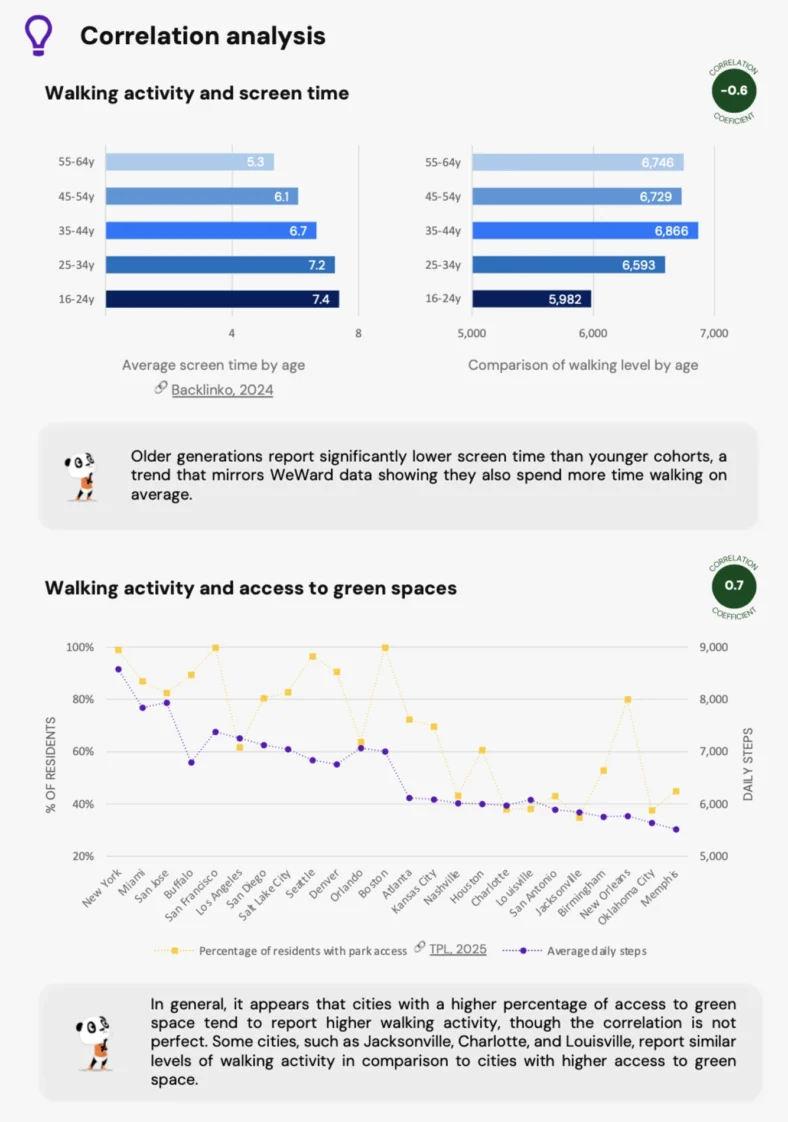
One of the more notable factors correlated with step count was how long people spend in front of a screen. According to the report, the higher the screen time, the lower the daily step count was, with 16 to 24-year-olds averaging the highest screen time and the lowest step count among age groups.
While those young adults are walking notably less than adults 25 through 64, their step count is trending positively, up 7% year-over-year.
Another significant demographic gap was found between men and women, with male users averaging a 26% higher daily step count.
Walking has increasingly become a more popular exercise modality, thanks to its accessibility. Google Data from earlier this year suggested walking workouts could explode in 2026, with modalities like Japanese walking topping the list of the fastest growing trends.
WeWard is capitalizing on that growth, with a global community of 30 million walkers on its gamified app, which rewards users for walking with rewards like cash deposits, retail gifts and charitable donations.
Last year, the brand received a significant boost from tennis star Venus Williams, who partnered with WeWard in a charity campaign to simultaneously uplift the importance of walking and donate money to alleviate global poverty.