In the first of a monthly FitGrid x ATN benchmarking data dive, we analyze the red-hot Pilates modality and what’s giving leaders in the field a leg up on member retention
During the chaotic post-New Year’s resolution period — when consumers try new activities and quickly abandon those that don’t resonate — top Pilates studios continued converting and retaining clients while average studios struggled.
These insights come courtesy of FitGrid, an intelligence platform that aggregates operational data from major booking systems across thousands of studios and turns it into valuable industry metrics.
To understand how the boutique fitness market is doing based on the data, and to help studios benchmark their own metrics against industry standards and learn from the leaders, Athletech News has partnered with FitGrid to present monthly deep dives on key metrics.
In the first of these data dives for ATN, FitGrid presents a snapshot of Pilates, and what is happening beneath the surface of this popular mega-modality.
Pilates Performance Is Bifurcated
The return rate of first-time clients has proven to be one of the strongest predictors of long-term studio revenue, and a key indicator of financial success. And while studios that successfully convert leads and retain first-time visitors generate significantly higher lifetime value, not all studios approach retention the same way.
Such disparity has led to a performance gap between top and average studios.
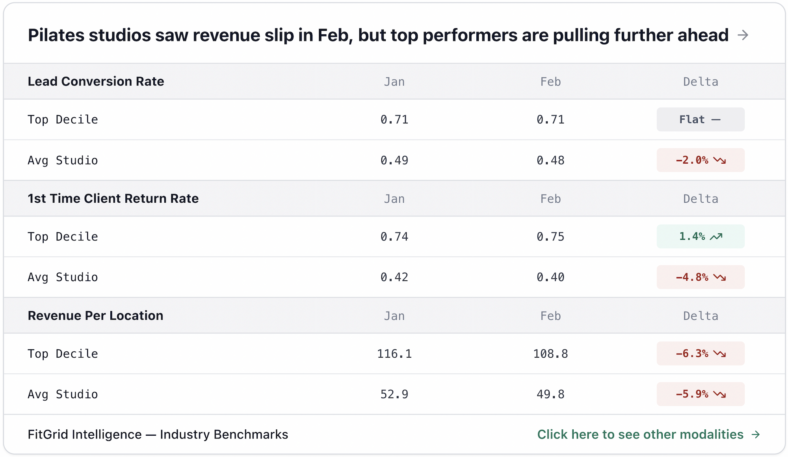
From January to February 2026, lead conversion and first-time return rates declined for average Pilates studios, while top-decile studios held conversion steady and slightly improved retention.
Top-decile studios performed better in both conversion efficiency and retention, showing flat yet higher lead conversion rates of 71% in February. Average studios saw conversion rates drop 2% that month from 49% to 48%.

Looking at first-time studio return rates during the period, top decile studios saw a 1.35% increase from 74% to 75%, while average studio return rates dropped 4.76% from 42% to 40%.
Top decile revenue per location did drop for top studios (as it did for the average studio), but their $108,000 core class revenue per location was more than double the $49,000 core class revenue per location of the average studio.
“The operational processes of top-decile studios set them up for a great year,” FitGrid founder and CEO Ntiedo “NT” Etuk told ATN. “Their methods of lead conversion and first-time client engagement are so good, they are literally bucking the market trend. It’s powerful to know that it can be done, and being at that level is what all studios should strive for.”
How Top Studios Win With Engagement
Further analysis suggests that studios with stronger community engagement and instructor relationships outperform their peers in these critical areas (particularly first-time return rates).
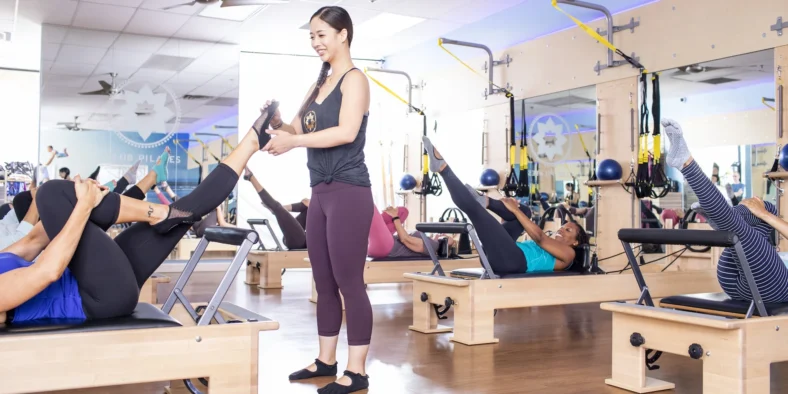
Instructors play a major role in the first experience and retention culture, and they employ a slew of methods to get clients back, from personally greeting first-timers and having classmates introduce themselves to sending personal follow-up messages.
The studio communities that relentlessly focus on such operations, measure the effectiveness of their efforts, and embed a process and culture around their practices are those that win. The top decile of studios needs such instructors to make first-timers feel connected to the studio.
“The instructor makes all the difference in the world. If you, as a client, get a message from an instructor after your first class, that matters,” said Etuk. “It shows the client that he or she matters. The best studios embrace that personal touch by having every client feel seen, acknowledged and supported.”
In a growing, popular and competitive modality like pilates, that little bit of acknowledgment seems to make a big difference.
Why Comparative Intelligence & Benchmarking Are Critical
By using comparative intelligence, studio operators, franchise brands and investors gain measurable insight into fitness industry performance trends and how their brands are doing compared to the rest of their modality, and how to do better.
This is critical because in the relatively young fitness and wellness industry — unlike hospitality, which has HVS, media, which has Nielsen, or even cars, which have JD Power — nobody really knows what “good” is.
“Ask a studio owner if their client acquisition rate is any good and they’ll likely tell you they’re not sure, or that it’s ‘good enough for them,’ said Etuk. “What they don’t know is whether it’s good enough for them to survive, or even thrive, in the market. Only benchmarking against the competition can tell them that.”
To solve that problem, Etuk, a serial tech entrepreneur, created FitGrid in 2018. He had become enamored of the fitness space, and started a studio to understand how technology could be used “to improve the success of businesses that help heal the world so much.”
His biggest insight, however, was how isolating the experience felt. He had no idea whether his studio performance was good or not, and had nobody to ask. And he felt many owners felt the same way.
“In a competitive world, absolute metrics are only partially useful. If they can’t illustrate performance compared to the industry, modality, or peer group — especially local peers — then they’re only telling you part of what you need to know to survive,” Etuk said.
“Your studio might be exhibiting a 40% retention rate, but is that good? It depends,” he added. “What are your competitors’ and peers’ retention rates? If their retention is much higher than yours, then any client that tries them is probably never coming to you. Worse, if you lose a client to them, they’re probably never coming back.”
To better address this issue, Etuk has FitGrid pull basic information from studios, via their booking platforms, then combines the data into a standardized set of metrics and definitions that could be used across the industry to describe key operational outputs (e.g.. lead conversion, at-risk %, revenue per instructor).
“Finally, there is something that helps you pinpoint what to spend resources, energy and dollars on to survive in your market,” Etuk said.
To understand how your studios compare to the market and to peers (anonymously), contact FitGrid.