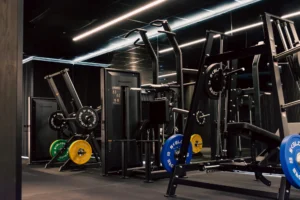
The fast-growing Miami-based brand has hired Roy Simonson, along with Freemotion founding member Hillis Lake, as it plans an all-new strength training line
Skelcore has bulked up its executive team as the fitness equipment and wellness technology company prepares for its next phase of growth
The Miami-based brand has brought aboard Roy Simonson, the founder of Eagle Fitness (later sold to Cybex) and a prolific designer credited with inventing the first cable-based circuit equipment, as head of product design.
Skelcore has also appointed Hillis Lake, a founding member of Freemotion Ground Zero, as head of U.S. sales. Taken together, the appointments signal the company’s ambition to revitalize the strength training equipment category across health clubs, boutique studios and global hotel chains.
“I consider Lake the best sales guy in the industry,” Simonson told Athletech News.
Lake is equally as complimentary of Simson, who has been a close friend for 35 years.
“In that time, we’ve stood in the ring together, supported each other through wins and more than a few ideas that started as sketches and ended up reshaping the fitness industry. … Roy believes in changing the status quo,” Lake told ATN. “He believes in building things that have never been built before.”
That long-running collaboration now has a new outlet. In his new role at Skelcore, Simonson will lead the development of a product line that promises to establish a new category of strength training hardware, one built on advanced biomechanics, variable resistance pathways and performance feedback systems that the company says are not found in conventional machines.
Though details remain close to the vest for now, select attendees at the upcoming HFA Show in San Diego will get a first look at the initial Skelcore 2.0 products designed by Simonson. Partner installations are expected to roll out by year’s end, according to Skelcore, whose equipment is found in over 60 countries and many U.S. gyms.
“We are incredibly excited to bring Roy’s work to market as part of Skelcore 2.0,” Skelcore founder and CEO Marc Ackermann said. “Combined with Hillis’s experience in the U.S. market, this marks a powerful step forward as we build a modern, AI-driven health and wellness company.”
The Right Time To Rethink Strength Equipment
For Simonson, who has spent decades in the fitness equipment industry, the new opportunity represents a chance to push beyond incremental improvements and drive genuine innovation.
“We’ve been kind of doing the same old thing for years and years and years, and there is absolutely nothing wrong with what we have been doing,” he said. “But there’s new movement patterns, there’s new methodologies, there’s new ways of applying load —there’s a lot of things that we can do to take the hardware, the strength products, to a new level.”
As he points out, the timing for innovation couldn’t be better, noting that strength training has seen explosive growth across demographics, embraced by people of all ages and abilities — a shift he believes will only accelerate. Though the industry may have missed the mark by focusing too narrowly on a specific customer segment, he says his mission with Skelcore is to broaden the appeal of strength training equipment.
“In recent years, manufacturers have really pretty much just focused on large, massive, masculine plate-loaded machines for the bodybuilding community,” Simonson said. “And while I have no problem with that, that really ignores 90-plus percent of most gym owners. I’m a firm believer in less is more. Make it simple, make it easy, make it approachable, make it so everybody can use it and make the experience better for the end user. And that’s what we’re trying to do.”
The data backs it up: Life Time’s latest wellness study found that strength training has emerged as the top health priority in 2026, which has led fitness operators and hotel gyms to rethink floor space to meet demand.