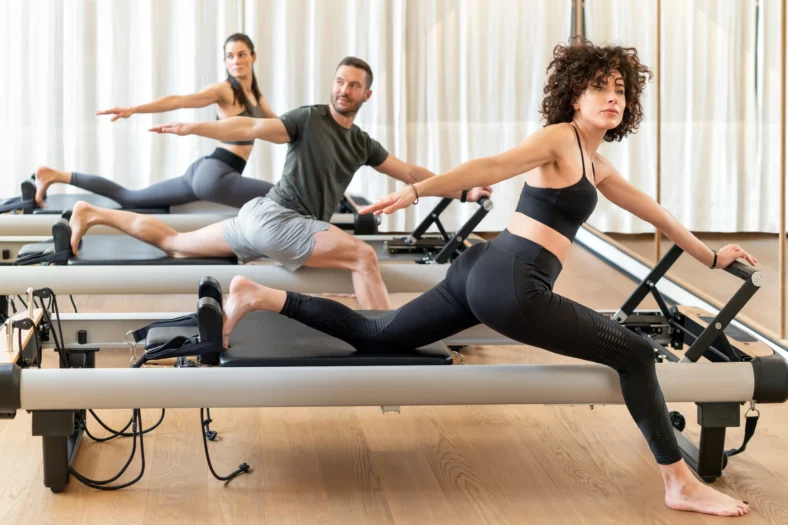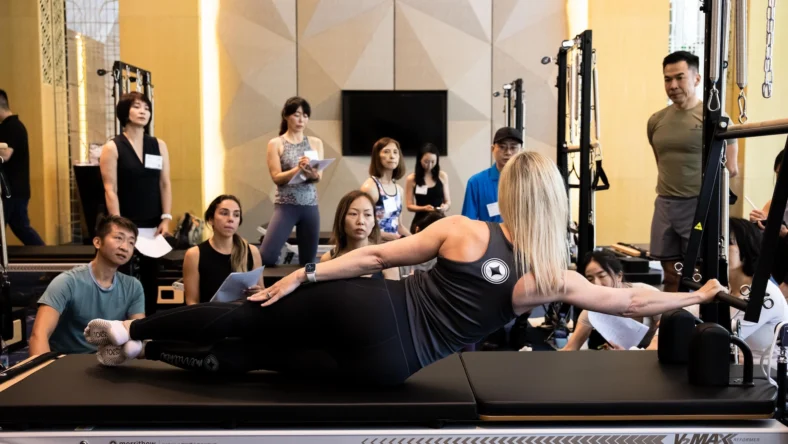
With the continued expansion of Pilates, instructor education is what keeps quality consistent and brands credible. Through STOTT PILATES®, Merrithew® illustrates how education has become a strategic engine for scale, trust and long-term growth.
Pilates has expanded into a global, multi-format category that now sits at the intersection of performance, longevity, rehabilitation and preventative health. Reformers dominate studio floors, hybrid classes blend strength and Pilates principles, and a broader, more diverse population is stepping into studios with higher expectations than ever before.
As the category scales, one factor has become the quiet determinant of whether a studio, concept or brand succeeds: instructor education.
While equipment innovation and studio design are a large part of the recipe for success, Merrithew, a global leader in Pilates education and equipment for more than 35 years, knows that education is the critical infrastructure that allows Pilates to grow without losing integrity.
“Instructors are managing more inputs than ever, including new equipment behaviors, digital tools, mixed-format sessions and diverse client needs. Education is where all that complexity is interpreted and made actionable in practice,” explains,Shannon Fable, Senior Vice President of Education at Merrithew.
That shift has fundamentally changed what it means to be an instructor today – delivery and execution can quite literally make or break a brand.
The Rising Bar for Pilates Instruction

As Pilates studios continue to open across the country and attract a broader range of fitness and wellness enthusiasts, demand for the modality is accelerating and, accordingly, the demands placed on instructors have grown. Clients now expect to be seen, corrected and coached as individuals, even in group settings. That expectation sits at the center of modern instruction.
“The key differentiator now is judgment. Knowing the work, seeing the person, landing the cue and knowing when you’re out over your skis. It demands a keen eye alongside physical execution,” Shannon says.
With Pilates becoming more athletic, more Reformer-focused and more visible through social media, instructors are constantly deciding how much load, resistance and complexity are appropriate. These decisions protect clients from strain, poor alignment and overly ambitious progressions and they shape how safe, effective and trustworthy the experience feels.
“Quality shows up in every clear cue, confident correction and instant adjustment that meets each client where they are,” explains Shannon.
“When education stops at memorizing sequences, instructors often hit a knowledge ceiling. They can run a class but feel unequipped when clients ask deeper questions or need individualized programming,” Shannon continues. “That can contribute to imposter syndrome and burnout.”
For studios, that gap shows up quickly. Clients can feel the difference between instruction that simply delivers a workout and instruction that adapts, responds and supports them as individuals. That difference determines whether Pilates operates as a premium, high-trust service or slides toward commoditization.
Continuing Education as Brand Infrastructure

As brands add complexity, continuing education becomes the mechanism that protects consistency, ROI and client trust. “When education doesn’t keep pace with innovation, the risk is dilution,” asserts Jim Heidenreich, Merrithew CEO. “Not as obvious failure, but as confusion, mixed results and a lack of confidence in what the brand stands for.”
Without a shared framework for teaching and decision-making, execution becomes inconsistent. Entry-level teaching alone is not sufficient. Equipment becomes underutilized or misapplied, and the client experience can suffer. “Instructors with depth know how to work the room”, says Shannon. The experience feels intentional, consistent and personal because the decisions behind it are grounded in understanding outcomes and the purpose of the equipment. That consistency is what drives retention, especially as studios scale or bring on new instructors.
This is where continuing education becomes a strategic necessity. “Certification sets a clear reference point. Continuing education keeps that reference intact as instructors move across roles, settings and expectations. Without it, drift sets in; with it, organizations safeguard consistency while expanding operations.” explains Shannon.
Through STOTT PILATES, Merrithew has built modular certification pathways, specialization tracks and ongoing professional development that support sound judgment over time. “Education is treated not as a single moment, but as a continuum. At an operational level, its risk management,” Shannon notes, “and performance insurance.”
Building Systems That Scale Without Dilution
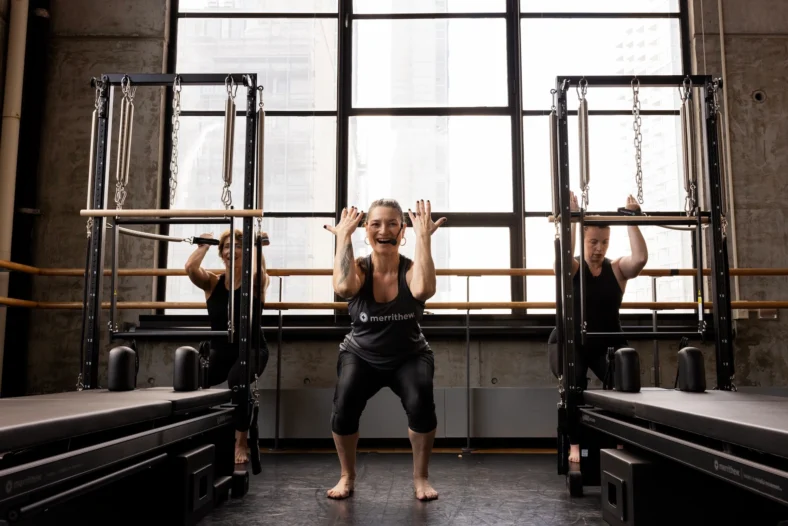
A defining element of Merrithew’s approach is that education and equipment are developed together.
“Education is grounded in biomechanics and functional anatomy,” Shannon underscores. “Instructors learn how load, alignment and resistance interact in the body, and how springs, setup and adjustability support those mechanics across different bodies.”
“When instructors understand both the intent of the equipment and the client’s goals, decisions stay clear and focused,” Shannon adds. “Instruction holds together across settings because application is driven by outcomes.”
“That same thinking shapes product design. Movement specialists, engineers and experienced Instructor Trainers collaborate to ensure consistency between how equipment is built and how it’s taught,” Jim emphasizes.
“Trust and retention are directly tied to business outcomes,” Jim shares. “If instructors don’t fully understand the capabilities and proper use of equipment, ROI suffers. The equipment becomes an investment without meaningful results.”
When asked what operators and owners should be thinking about today to future-proof their Pilates offerings over the next five to 10 years, Merrithew says it comes down to decision quality at scale.
“Equipment, digital tools and demand will continue to change,” Jim notes. “What matters is whether standards, scope and expectations remain clear as those changes occur.”
For executives and operators, that means building a visible development framework. “Think of it as building a talent pipeline over and above a hiring pipeline,” Jim says.
That pipeline only works when expectations are clearly defined and consistency is reinforced over time. “Standards are a ladder: same bar, clear lanes and real support. When studios hold up over time, they protect the roots while letting the branches expand,” Jim says.
If there’s one mindset shift Merrithew wishes more operators would make, it’s this: education is not content delivery. It’s decision support.
“It is a continuum, and entry doesn’t equal mastery,” comments Shannon. “This approach matters because complexity is embedded in the business.”“We’re in a time of rapid acceleration, both across the industry and in digital transformation,” Jim concludes. “When education is built this way, it preserves quality, prevents dilution and gives teams the foundation to grow.”