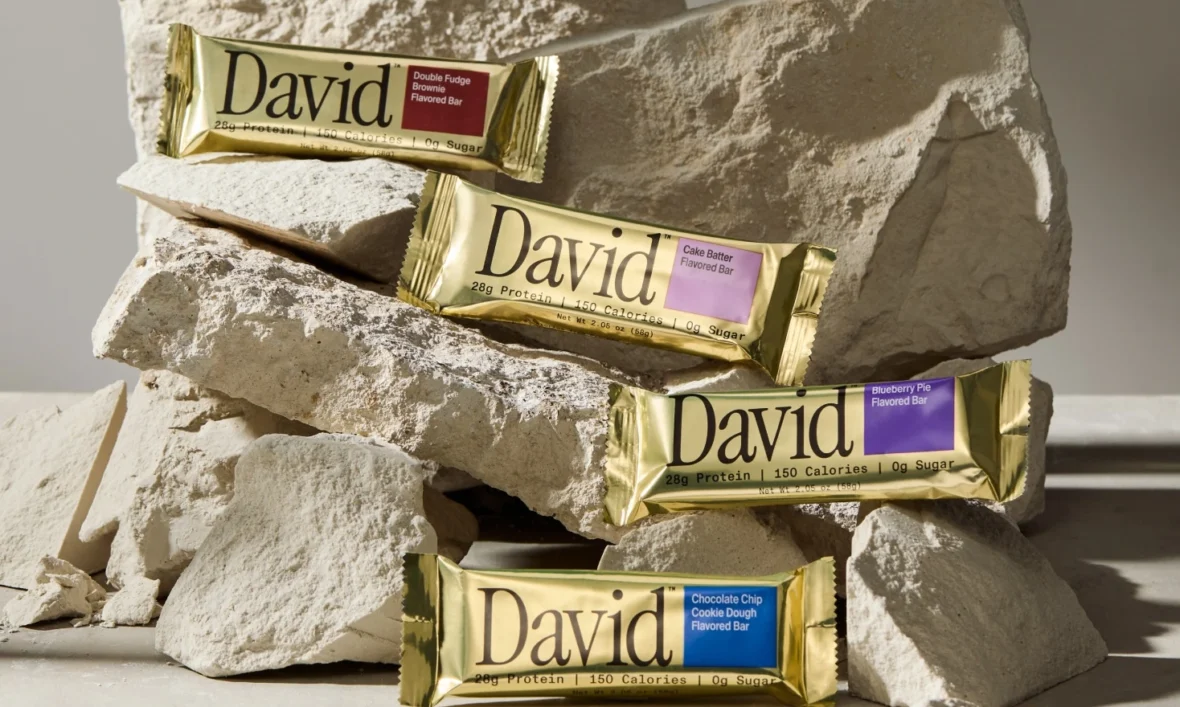
The popular protein brand asserts the class-action claims are unfounded, saying it stands by its claim that its bars contain only 150 calories. Plaintiffs allege the bars contain as many as 275 calories and 13.5 grams of fat
A class action against David Protein is putting the brand’s nutritional content into question, asserting the brand engaged in “deceptive practices in labeling and marketing the calories and fat content in its consumer food products.”
The suit, filed in January, alleges that the bars have approximately 80% more calories and as much as 400% more fat than labeled, based on testing conducted at an “accredited laboratory.”
The popularity of David bars has largely hinged upon the brand’s high-protein, low-fat, low-calorie marketing, with each product labeled to have 28 grams of protein, zero grams of sugar, 2 grams of fat, 12 grams of carbs and only 150 calories — one of the best protein-to-calorie ratios on the market.
But according to the lawsuit, lab testing found the bars had between 268 and 275 calories, with fat totals ranging from around 11.8 grams up to 13.5 grams.
That far exceeds the margin of error permitted by the Food and Drug Administration (FDA), which allows labeled caloric content to be within 20% of the measured amount.
If the claims are true, it would mean David violated the FDA’s regulatory act, the Federal Food, Drug and Cosmetic Act (FDCA), as well as state consumer protection laws.
The lawsuit also highlights how health-conscious customers, often preoccupied with calories and fat content were misled, and the suit indicates that if the labels were accurate, “reasonable” consumers would not have purchased them or would have paid less for David bars.
However, David fully disputes the claims, with a spokesperson telling Athletech News, “The lawsuit is based on a scientific misunderstanding about how calories are measured.”
The brand asserts that the method of measuring calories used by plaintiffs isn’t an accurate calculation method that reflects the energy the human body can actually absorb and use, and doesn’t account for the fact that the body metabolizes sweeteners and fat substitutes like EPG — one of the hallmark ingredients of David bars — differently.
“The David bar is 150 calories, and we stand behind the accuracy of our labeling,” the spokesperson told ATN.
Whatever the legal merits, the dispute amplifies existing concerns about how much consumers can trust the supplements and protein products they’re buying.
Last year, a report from supplement maker Thorne revealed that consumers struggle to decide which products to buy — and who to trust — amid a sea of conflicting information, with over half (57%) of respondents unsure which products are best suited for their individual needs, while 56% said there’s too much conflicting information about supplements.
What also didn’t help that shaky confidence were the explosive findings out of Consumer Reports, which discovered unsettling amounts of lead in some of the top protein powders on the market.