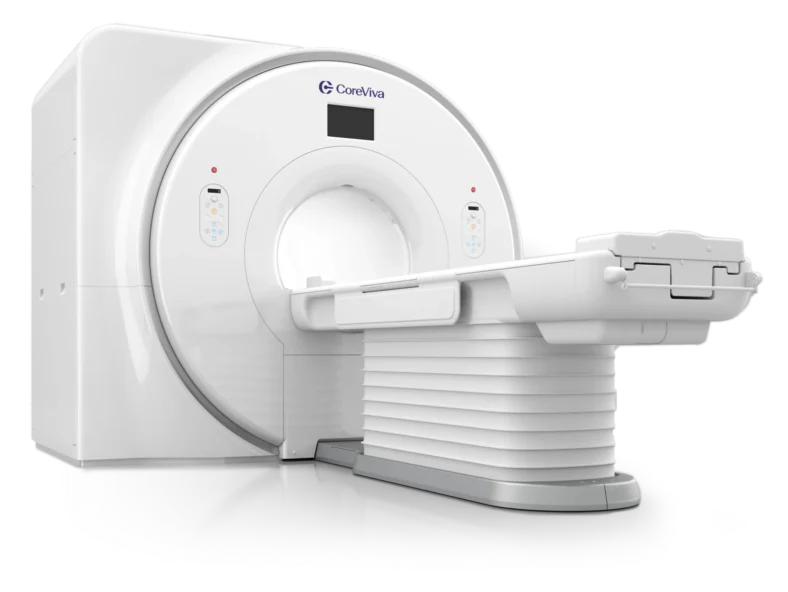
Founded by two board-certified radiologists, the new Newport Beach clinic offers a more comprehensive and patient-focused approach to diagnostic imaging
As whole-body MRI gains traction in the realm of proactive health screening, a new venture led by physicians hopes to improve both the accuracy and experience of diagnostic imaging. CoreViva, founded by radiologists Dr. A. Alexander and Dr. Brian Tsui, officially opened its flagship clinic in Newport Beach, California, this month after operating in stealth for two years.
The founders bring experience from academic medicine and professional sports and note that the idea for CoreViva stemmed from repeated gaps they observed in standard whole-body MRI offerings.
“Working as a team physician for the LA Lakers and Dodgers showed me how transformative early detection can be in high-performance environments,” said Dr. Alexander, a board-certified radiologist who previously led global medical imaging at McKinsey & Company. “I founded CoreViva because I realized nothing in the market met our high bar for optimal patient screening and care.”
Dr. Tsui, formerly on faculty at UCSF, described how early encounters with whole-body MRI revealed significant quality issues in the existing landscape.
“My first exposure to whole-body MRI was seeing patients at UCSF for follow-up scans because their previous scans were read incorrectly, resulting in many false positives and false negatives,” he said. “I encountered patients experiencing unnecessary anxiety because they were told they had a serious finding on their whole-body MRI, yet when they were scanned at my facility they had a completely normal scan! I’ve also encountered patients who were told they had normal scans, but due to persistent symptoms, came to UCSF for repeat imaging and unfortunately had a missed diagnosis.”
CoreViva’s model centers on physician-led scan interpretation, supported by upgraded imaging hardware and AI tools intended to improve scan speed and clarity without compromising accuracy.
“There are two key technological advances: hardware and software,” explained Dr. Tsui. “Our higher-density coils pick up better signals for superior image quality, while our AI algorithms process images to maintain clarity even when acquired more quickly, so a faster scan doesn’t mean a fuzzier image. We have also built AI that helps distinguish between harmless findings and serious cancers, increasing accuracy and reducing false positives.”
“But technology alone isn’t enough,” he continued. “That’s why every CoreViva scan is interpreted by a board-certified radiologist who then meets one-on-one with the patient. This physician-led model ensures that advanced imaging is paired with clinical expertise, which is essential for both accuracy and meaningful patient care.”
Unlike traditional imaging centers, where patients rarely speak with the radiologist who interprets their scan, CoreViva integrates direct consultation as part of the care model.
“Our 1:1 consultations eliminate any uncertainties that patients might have,” said Dr. Tsui. “Patients can ask questions directly and understand exactly what their scan means. As a radiologist, I love being able to provide that clarity: taking a million different possibilities and distilling them down to ‘this is what’s happening in your body.’”
The company also includes personalized metrics like brain age, musculoskeletal age, and visceral fat levels to help patients monitor their health over time.
“Our personalized CoreViva Scores give patients tangible metrics they can track and act upon,” said Dr. Alexander. “Instead of just telling someone they have increased visceral fat, we quantify it and show how it compares to their age group, giving them a clear target for improvement. These scores turn abstract health concepts into actionable data points. Over time, patients can see whether their interventions, like diet, exercise, and lifestyle changes, are working.”
The founders see CoreViva as part of a broader shift in preventive medicine, one that favors early detection and longitudinal tracking over reactive care.
“Whole-body MRI represents a fundamental shift toward proactive rather than reactive healthcare,” said Dr. Alexander. “As technology continues advancing and we build stronger evidence for outcomes, I see whole-body MRIs becoming as routine as annual physicals.”
Dr. Tsui added that the company’s mission is deeply personal. “What drives me every day are the stories of people I know: a young person with lung cancer who’s never smoked, a family friend’s daughter who died from a brain aneurysm that could have been detected,” He said. “These conditions don’t discriminate by age, and traditional screening often misses them. And the research backs this up. Even though the incidence of early-onset cancer has increased by 80% in the last 30 years, less than 15% of cancers are caught by standard screening tests. We want to give people the knowledge to make informed decisions about their health, and save lives.”