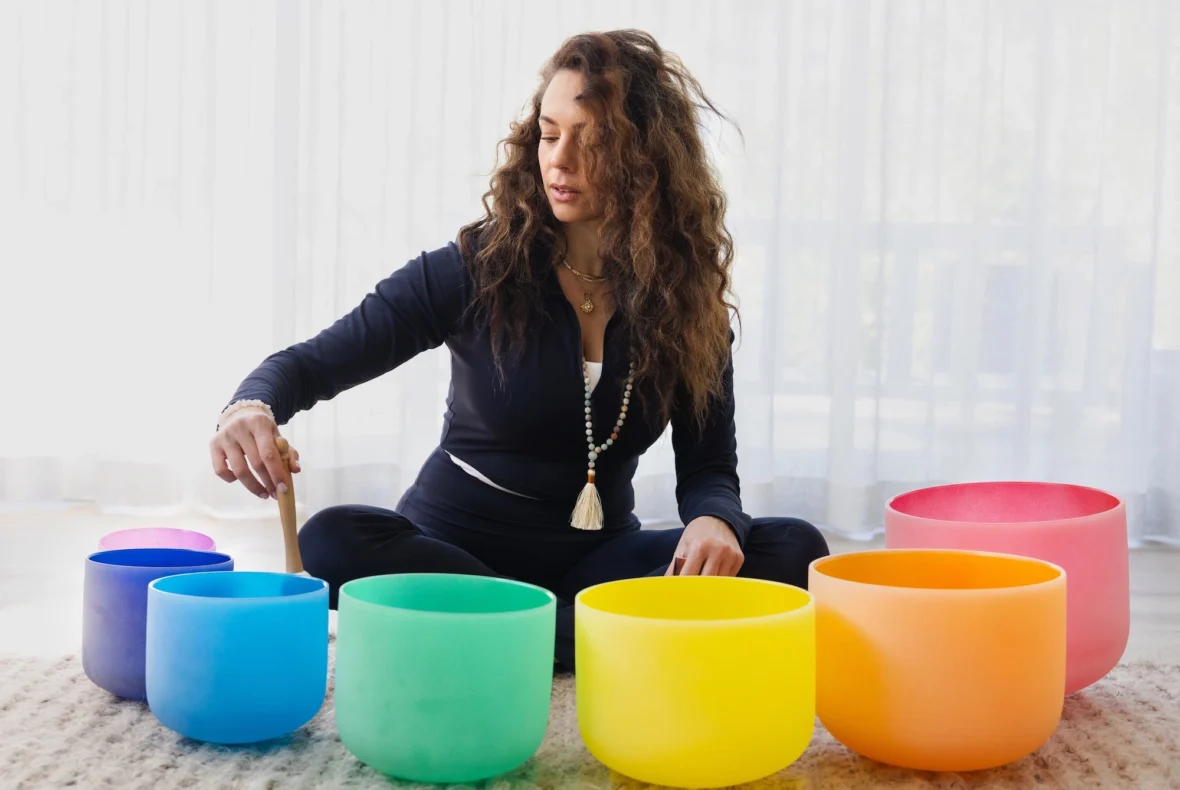
As recovery and longevity move to the center of the fitness and wellness experience, sound therapy is emerging as a scalable tool for nervous-system regulation. Here’s how operators are integrating sound into programming, why execution and education matter and what makes sound commercially viable across the industry.
What began as a practitioner-led wellness modality is now being integrated by gyms, studios, wellness clubs and hospitality operators as a core recovery and nervous-system support tool—one that fits naturally within the modern fitness and wellness ecosystem.
When implemented correctly, sound is emerging as a scalable answer to a growing challenge. Members want recovery and regulation built into the experience, and operators need solutions that deliver these outcomes without expanding square footage, staffing complexity or clinical infrastructure.
That’s where Rainbow Sounds enters the equation. As a global manufacturer and educator specializing in precision-tuned crystal sound bowls, Rainbow Sounds has seen growing adoption across fitness, wellness and hospitality environments as an operational tool for recovery, regulation and retention.
Their approach emphasizes particular technique training backed by science and mathematical music formations with their facilitator education, which are details that matter when sound is used intentionally rather than decoratively. For operators, that distinction is critical.
The modern fitness consumer is more fatigued than ever. They train hard and they also live in a state of high stress, poor sleep and constant cognitive load.
As a result, recovery is no longer defined solely by muscle repair. It’s increasingly understood as nervous-system regulation—the ability to shift from a sympathetic (fight-or-flight) state into a parasympathetic (rest-and-restore) one.
Sound-based practices offer a low-impact way to support that shift.
Emerging research supports this application. An observational study examining singing-bowl sound meditation found that participants experienced significant reductions in tension, fatigue, anger and depressed mood following a session, alongside increases in overall well-being. A broader systematic review of clinical studies suggests that singing-bowl-based sound therapy may help alleviate anxiety and depression, improve sleep quality and influence physiological markers related to brainwave activity.
For operators, the relevance is clear: stress reduction, recovery support and improved sleep are directly tied to consistency, adherence and long-term engagement.
The industry is moving away from “Sound Healing” to into Integrated Programming

What’s changing is not just interest in sound, but how it’s being deployed.
Rather than standalone events, operators are integrating sound as therapy into existing programming in ways that align with performance and recovery goals:
- Post-strength or conditioning recovery sessions
- Breathwork and mobility classes
- Guided rest following high-intensity training
- Standalone nervous-system recovery offerings during off-peak hours
Because sound therapy sessions require minimal space, equipment or physical exertion, they offer a rare combination of low operational lift and high experiential impact.
According to Rainbow Sounds, operators are increasingly framing these sessions as “sound experiences,” “guided recovery,” or “nervous-system reset” classes—language that resonates with performance-oriented audiences.
This reframing matters. It allows sound to sit comfortably alongside strength, conditioning and mobility, rather than feeling like a departure from them.
And while sound may seem simple to deliver, effectiveness depends on execution.
Sound-based recovery relies on consistent frequencies and harmonic relationships that support relaxation, attentional shift and downregulation. Poorly tuned instruments or untrained facilitation can undermine the experience or even reduce it to little more than background ambiance.
That’s why quality education is becoming central to adoption.
Rainbow Sounds provides both the instruments and facilitator training, helping operators ensure sessions are delivered safely, consistently and professionally. For studios or clubs positioning recovery as part of a premium experience, this structure is essential.
As one operator put it: members don’t need to understand the science, they need to feel the difference.
Operators are also reporting that members who participate in structured recovery experiences are more likely to return, explore additional formats and view the facility as a place for both performance and restoration.
Sound sessions introduce stillness into environments that are otherwise high-energy. They create contrast, and contrast is memorable.
Because sound-based experiences are accessible across age groups and fitness levels, they also help studios broaden engagement without changing their core identity. A strength-focused gym doesn’t become “less serious” by offering nervous-system recovery. It becomes more complete.
The Commercial Case for Sound

From a business standpoint, sound-based recovery checks several important boxes:
- Lower capital investment compared to equipment-heavy recovery modalities
- Minimal staffing requirements once facilitators are trained
- Flexible programming across peak and off-peak hours
- Strong alignment with longevity, recovery and mental wellness trends
For operators looking to expand offerings without expanding complexity, sound provides a scalable option. It also creates differentiation in a crowded market.
As the fitness and wellness industry continues to evolve toward more holistic, longevity-oriented models, recovery and regulation will become non-negotiable components of the experience.
Sound-based practices, when executed with intention and credibility, offer operators a way to meet that demand efficiently and effectively.
In an industry built on movement, stillness may be one of the most underutilized tools available.